 Dr. Fernando Escobar
Home › Patient guides › Venous thrombosis
Venous thrombosis
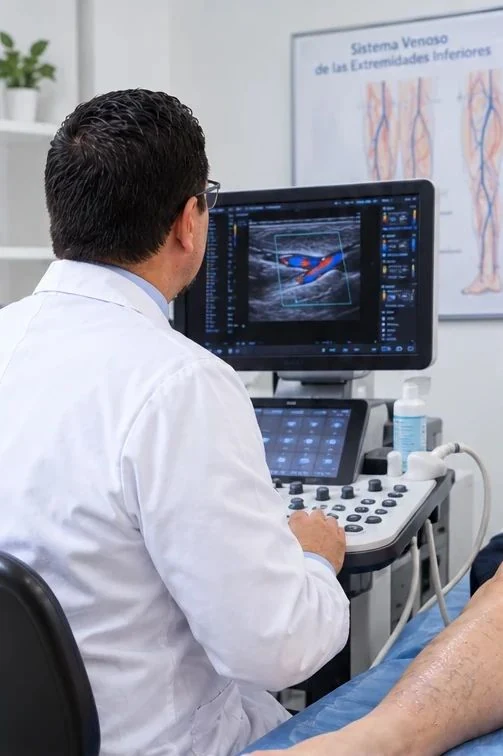
Venous thrombosis is the formation of a clot (thrombus) inside a vein, almost always in a leg. It can block the flow of blood and cause swelling and pain. Most importantly, the clot can break loose and travel to the lungs (pulmonary embolism), which is an emergency. That is why it needs prompt medical assessment. It is confirmed with Doppler ultrasound and is mainly treated with anticoagulants prescribed and monitored by the doctor.
In summary
- It is a clot inside a vein, most common in the legs.
- Typical symptoms: swelling, pain, warmth and redness in one leg only.
- It is confirmed with venous Doppler ultrasound.
- The main treatment is anticoagulants, with medical follow-up.
- Difficulty breathing or chest pain is an emergency.
What is venous thrombosis?
It occurs when a clot forms in a vein. If it forms in the deep veins, it is called deep vein thrombosis (DVT) and it is the more serious one, because the clot can travel to the lungs. If it forms in a superficial vein (phlebitis or superficial venous thrombosis), it is usually less serious, but it should also be assessed by a doctor.
Symptoms
- Swelling of one leg only or of the calf.
- Pain or tenderness, sometimes like a cramp that will not go away.
- Warmth and redness or a purplish skin color.
- Superficial veins that look more visible than usual.
Some people have no symptoms. If in doubt, it is better to get checked.
Causes and risk factors
- Prolonged immobility: bed rest, hospitalization or very long trips.
- Recent surgery and fractures.
- Pregnancy and the postpartum period.
- Use of contraceptives or hormone therapy.
- A previous thrombosis or a family history.
- Certain diseases, such as cancer, and clotting disorders.
- Obesity and older age.
How it is diagnosed
The doctor evaluates your symptoms and risk factors and performs a venous Doppler ultrasound, the main exam to see whether there is a clot. In some cases blood tests or other studies are requested.
Treatment
- Anticoagulants: they prevent the clot from growing and new ones from forming, while the body gradually dissolves it. The doctor decides which one and for how long, depending on the cause.
- Regular follow-up to monitor progress and adjust treatment.
- Walking and staying active, when the doctor indicates it.
- Compression stockings, if the doctor recommends them, to relieve swelling. More information in compression stockings.
- In selected cases, other procedures or hospital care.
Do not stop or change your medications on your own.
Possible complications
- Pulmonary embolism: the clot reaches the lungs.
- Post-thrombotic syndrome: pain, chronic swelling and skin changes that can lead to venous ulcers.
- New thromboses.
How to reduce the risk
- Move often if you spend a lot of time sitting or on long trips, and stay well hydrated.
- Follow your doctor's instructions after surgery or prolonged bed rest.
- Keep a healthy weight and avoid smoking.
- If you have a history, ask before long trips, surgeries or hormone treatments.
When to seek urgent care
- Difficulty breathing, chest pain, coughing up blood, fainting or palpitations: go to the emergency department immediately (it may be a pulmonary embolism).
- A recently swollen, painful, warm and red leg: seek care the same day.
Frequently asked questions
Is thrombosis the same as varicose veins?
No. Varicose veins are superficial veins widened by valves that do not work well. Thrombosis is a clot inside the vein and can be dangerous. You can have both.
Can I walk if I have a thrombosis?
In general yes, and it is usually recommended once the doctor starts treatment. Always follow their instructions.
How long does treatment last?
It depends on the cause and on each patient's risk. It can range from a few months to longer periods. The doctor defines it and reviews it at follow-up visits.
Does Doppler ultrasound detect clots?
Yes. It is the most widely used exam to see whether there is a thrombus in the leg veins.
Do anticoagulants dissolve the clot?
They prevent it from growing and new ones from forming, and they let the body gradually dissolve it over time.
Would you like an assessment? Message us on WhatsApp.
Book via WhatsAppThe information on this page is general and for guidance only. It does not replace a medical consultation. If you have a warning sign, go to the emergency department. The pages are written for patients in Colombia; consultations are in Spanish.
Last updated: October 15, 2026