 Dr. Fernando Escobar
Home › Patient guides › Sclerotherapy
Sclerotherapy
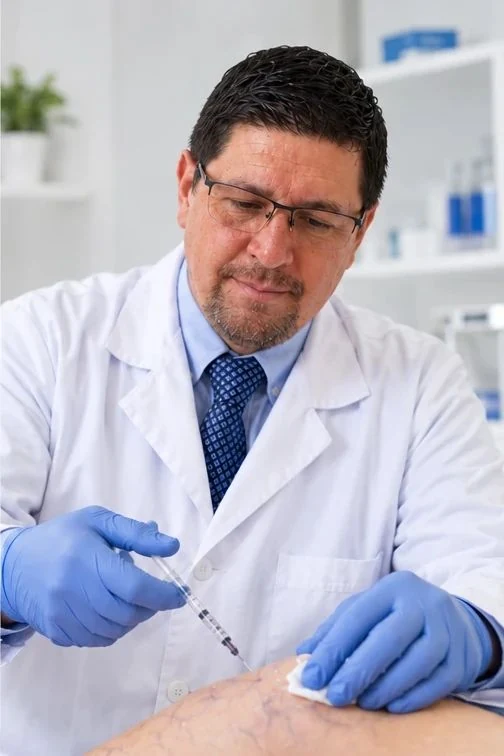
Sclerotherapy consists of injecting a medication (a sclerosing agent) into a vein that irritates its wall and makes it close; over time, the body reabsorbs it. It is used to treat spider veins, reticular veins and small or medium varicose veins. It is a quick outpatient procedure without general anesthesia, and results appear gradually over weeks or months.
In summary
- It is used for spider veins and small or medium varicose veins.
- Each session lasts between 20 and 30 minutes and several sessions may be needed.
- You walk the same day, with the compression your doctor prescribes.
- Bruising and temporary marks are common; serious risks are rare.
What is it and what is it for?
A sclerosing liquid or foam is injected with a very fine needle into the diseased vein. The vein becomes inflamed, closes and stops being visible as the body absorbs it. For veins that cannot be seen with the naked eye, the injection can be guided with ultrasound.
It is used for spider veins, reticular veins (the fine bluish ones) and small or medium varicose veins. Larger varicose veins may need another technique, such as endovenous treatment.
Who is it for?
It is an option for many people with small or medium veins, whether for cosmetic reasons or because of symptoms (heaviness, pain). Before deciding, the doctor performs an assessment and, if there are larger varicose veins or suspected reflux, a Doppler ultrasound.
It may be postponed or not recommended in cases of pregnancy or breastfeeding, recent or active venous thrombosis, allergy to the medication or infection in the area. The doctor also reviews history such as thrombosis, allergies, migraine with aura and heart disease.
How it is done
- Assessment of the legs and definition of the veins to treat.
- Cleaning of the skin.
- Injections with a very fine needle; some guided by ultrasound.
- Afterward, compression (a bandage or stocking) is applied as the doctor indicates.
A typical session lasts between 20 and 30 minutes. Depending on how extensive the problem is, several sessions may be needed, with two to four weeks between each one.
After the procedure
- Walk the same day and stay active.
- Wear the compression for the time prescribed.
- Avoid direct sun on the treated area, intense heat (saunas, very hot baths) and intense exercise for the days your doctor indicates.
- Attend the follow-up visit to assess the result.
Results
They improve little by little: the finest veins may fade within weeks, while larger ones take longer, sometimes months. Some areas need touch-up sessions. Sclerotherapy treats the veins that already exist, but it does not prevent new ones from appearing over the years.
Possible discomfort and risks
Common and usually temporary:
- Bruising, itching, redness or mild pain in the area.
- Dark marks over the treated vein, which can take months to fade.
- Small new vessels appearing around the treated area.
Less common: inflammation of a superficial vein or a small skin wound if the medication leaks out of the vein. Very rare: allergic reaction, thrombosis or temporary vision or neurological disturbances. The doctor explains these risks before starting.
When to seek urgent care
- Severe pain or swelling of the leg.
- Redness, warmth or painful hardness along a vein.
- Difficulty breathing or chest pain.
- Vision changes, severe headache or weakness.
- Widespread hives or swelling of the face or lips.
Frequently asked questions
Does it hurt?
You feel a slight prick, because the needle is very fine. Afterward there may be a brief burning or discomfort. It does not require general anesthesia.
How many sessions do I need?
It depends on the number and size of the veins. There may be several sessions, with two to four weeks between each one. The doctor decides during the assessment.
When will I see results?
Gradually: within weeks for fine veins and up to months for larger ones.
Can I exercise?
Walking is recommended from the same day. Intense exercise is avoided for the days your doctor indicates.
Does it work for large varicose veins?
Large varicose veins with reflux usually need another technique, such as ultrasound-guided endovenous treatment. In some selected cases sclerosing foam is used with ultrasound guidance. The doctor decides after studying the veins.
Would you like an assessment? Message us on WhatsApp.
Book via WhatsAppThe information on this page is general and for guidance only. It does not replace a medical consultation. If you have a warning sign, go to the emergency department. The pages are written for patients in Colombia; consultations are in Spanish.
Last updated: October 15, 2026