 Dr. Fernando Escobar
Home › Patient guides › Venous and arterial Doppler ultrasound
Venous and arterial Doppler ultrasound
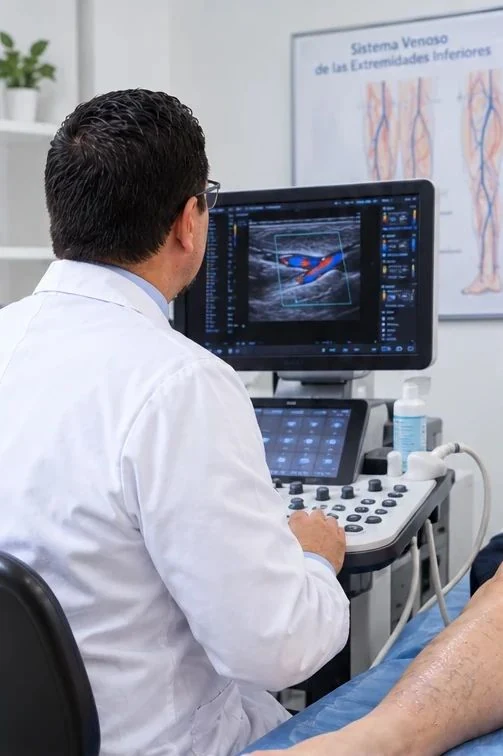
Duplex Doppler ultrasound is an exam that uses sound waves to show the structure of veins and arteries and to measure the speed and direction of blood flow. It uses no radiation and does not hurt. It helps find out why there are varicose veins, swelling or wounds on the legs, rule out a thrombosis and plan treatment. It is the basic study of any vascular assessment.
In summary
- It is painless, uses no radiation and is done in the office.
- The venous study detects reflux and clots and allows the veins to be mapped.
- The arterial study checks whether blood is flowing well to the legs.
- It does not usually need special preparation or fasting.
What is it and what does it show?
It combines two technologies: ultrasound, which forms an image of the veins and arteries, and Doppler, which measures whether blood is flowing, in which direction and at what speed. Gel is applied to the skin and a small sensor is moved along the leg.
What is it requested for?
- Varicose veins, heaviness, swelling or tired legs.
- Before a treatment, to decide which one is most suitable, and afterward, to check the result.
- Ulcers or wounds that are slow to heal.
- Suspected deep vein thrombosis.
- Pain when walking, coldness or color changes in the foot, which may point to an arterial problem.
Venous study and arterial study
Venous
It allows the valves to be seen, reflux (blood flowing down when it should flow up) to be detected, clots to be found and a map of the veins to be drawn, which helps plan treatments for varicose veins.
Arterial
It checks for narrowing or blockages that reduce blood flow to the legs. It is especially important in people with ulcers before compression is prescribed.
How to prepare
- Wear comfortable clothes that let you uncover your legs.
- It does not usually require fasting.
- Keep taking your usual medications, unless your doctor says otherwise.
- If you have previous studies, you can bring them, although it is not required.
How it is done
To assess the veins, the study is often done with the person standing or semi-seated, because reflux is easier to see that way, and maneuvers such as gently squeezing the calf are used. Its length depends on what needs to be evaluated: it can be shorter or longer depending on the case.
The findings are explained during the same consultation and the doctor defines the treatment plan based on them.
What to keep in mind
- The quality of the result depends on the experience of the person who performs and interprets the exam. It is best if it is done by a professional trained in vascular ultrasound.
- The study does not replace the clinical examination: the two complement each other.
- In some cases other additional tests are needed.
When to seek urgent care
Do not wait for a routine appointment if you have sudden swelling, redness, warmth and pain in one leg only, chest pain or difficulty breathing, or a cold, pale or purple foot. Go to the emergency department.
Frequently asked questions
Does Doppler ultrasound hurt?
No. You only feel the gel and the light pressure of the sensor. It is an exam without needles or radiation.
Does it have risks?
Diagnostic ultrasound is considered a safe exam, with no radiation or needles. That is why it can also be done during pregnancy.
Do I need previous tests before the consultation?
You do not need to bring previous tests. At the first visit the clinical examination is done and, if needed, a vascular Doppler ultrasound in the same office.
Can it tell me if I have a thrombosis?
Yes. Doppler ultrasound is the most widely used exam to detect clots in the leg veins.
When are the results given?
The findings are explained during the same consultation.
Would you like an assessment? Message us on WhatsApp.
Book via WhatsAppThe information on this page is general and for guidance only. It does not replace a medical consultation. If you have a warning sign, go to the emergency department. The pages are written for patients in Colombia; consultations are in Spanish.
Last updated: October 15, 2026